Total: $0.00
Taxes and shipping calculated at checkout


Time to shop! Find your favorite product, check the latest collection & don’t miss out the best discounts!


You’ve probably heard that keeping your hair moisturized is essential for shine and growth, but not all moisturizers work the same way. Many people assume any product labeled “hydrating” will deliver results, yet they still struggle with dryness, frizz, or lackluster hair. The secret lies in understanding humectants, ingredients that actively attract and bind moisture to your hair shaft. These powerful compounds can transform your hair’s hydration, elasticity, and overall health when used correctly. This guide explains how humectants work, when they help or hinder your hair, and how to use them effectively for maximum shine and growth.
| Point | Details |
|---|---|
| Humectants attract moisture | They use hydrogen bonding to pull water from the air into your hair shaft, improving hydration and elasticity. |
| Humidity affects performance | In low humidity below 35°F dew point, humectants can dry hair out; above 60°F, they may cause frizz. |
| Hair porosity matters | Damaged or bleached hair absorbs excess moisture easily, leading to more frizz in humid conditions. |
| Balance with oils and proteins | Combining humectants with emollients and proteins prevents over-absorption and strengthens hair. |
| Monitor weather conditions | Adjust your humectant use based on local dew points to avoid dryness or frizz. |
Humectants are moisture-attracting substances that bond with water molecules and deliver them directly to your hair. Unlike oils that seal moisture in, humectants attract and bind moisture to hair via hydrogen bonding, hydrating the shaft, improving elasticity, reducing frizz, and enhancing shine. This process involves adsorption, where water molecules cling to the surface of your hair strands, penetrating the outer cuticle layer.
When humectants work properly, they increase your hair’s ability to stretch without breaking. This elasticity is crucial for preventing damage during styling, detangling, or everyday wear. Curly and coily hair types benefit most because their spiral structure makes it harder for natural oils from the scalp to travel down the hair shaft. Without adequate moisture, these hair types become dry, brittle, and prone to breakage.
Common humectants you’ll find in hair products include panthenol (provitamin B5), glycerin, honey, aloe vera, and hyaluronic acid. Each works slightly differently, but all share the same core function of drawing water into your hair. Panthenol, for example, penetrates deeper into the hair cortex than many other humectants, forming hydrogen bonds that directly strengthen the internal structure. This makes it particularly effective for improving tensile strength and reducing breakage.
Pro Tip: Look for natural hair hydrators in the first five ingredients of your shampoo or conditioner to ensure you’re getting enough humectant power.
The effectiveness of humectants depends heavily on environmental conditions and your hair’s unique characteristics. Understanding these factors helps you choose the right products and avoid common pitfalls. For those with curly hair, check out this hydrated curls guide to learn more about selecting products that work with your texture.
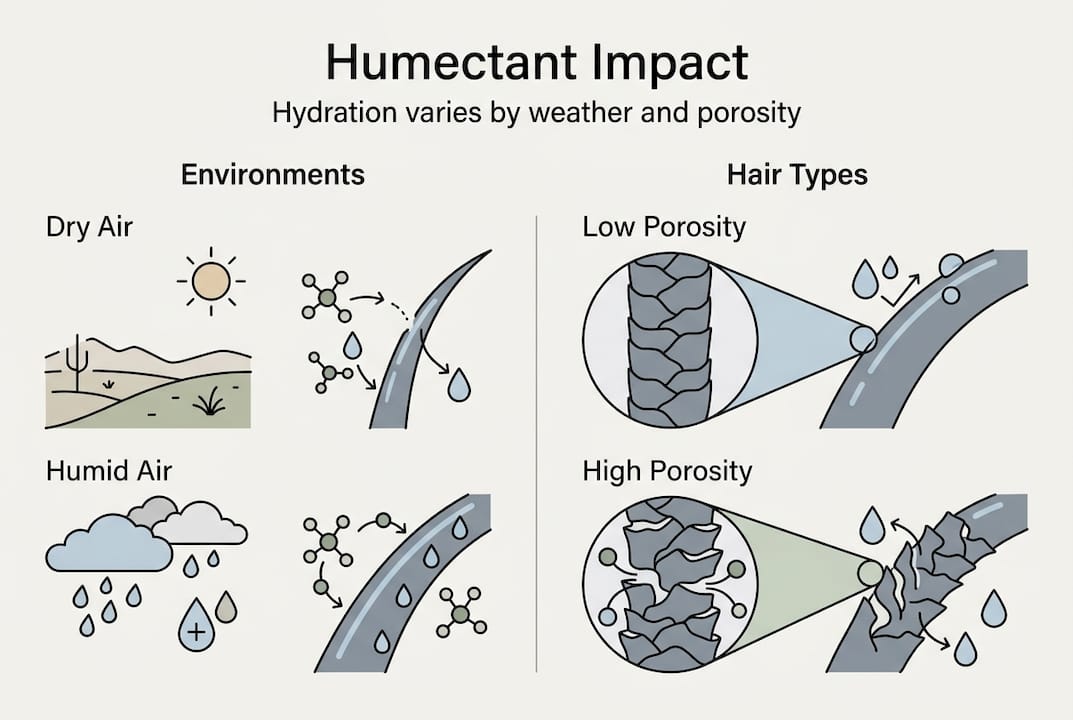
Humectants don’t perform the same way in all weather conditions. In low humidity or dew points below 35°F, humectants draw moisture from hair itself, causing dryness and brittleness. When there’s not enough water vapor in the air, these ingredients reverse their function and pull moisture out of your strands instead of into them. This leaves your hair feeling parched and looking dull.
The sweet spot for humectant performance is between 35°F and 50°F dew point. In this range, there’s enough atmospheric moisture for humectants to draw water from the air without overdoing it. Your hair stays hydrated, soft, and manageable. However, when humidity climbs above 60°F dew point, excess moisture leads to frizz and swelling, especially in porous or damaged hair. The hair shaft absorbs too much water, causing the cuticle to lift and create that fuzzy, undefined look.
Your hair’s porosity plays a massive role in how humectants affect you. Porosity refers to how easily your hair absorbs and retains moisture. Bleached or porous hair absorbs more moisture and frizzes more, with frizz ratio correlating directly with sorption levels. When your hair has been chemically treated or damaged by heat, the cuticle layer has gaps and openings that allow water to rush in uncontrolled. This creates volume in all the wrong places.

| Humidity Range | Humectant Effect | Best for Hair Type |
|---|---|---|
| Below 35°F dew point | Pulls moisture from hair, causes dryness | Avoid humectants, use heavy oils |
| 35-50°F dew point | Optimal hydration from air | All hair types, especially low porosity |
| 50-60°F dew point | Good hydration, slight frizz risk | Normal to high porosity with balance |
| Above 60°F dew point | Excess absorption, frizz and swelling | Use anti-humectants or gels instead |
Low porosity hair has tightly sealed cuticles that resist moisture absorption. These hair types need lighter humectants and may benefit from heat to help products penetrate. High porosity hair, on the other hand, drinks up moisture quickly but struggles to retain it. For these strands, you need to balance humectants with proteins and oils to prevent over-absorption.
Pro Tip: Panthenol stands out because it penetrates the cortex and forms hydrogen bonds, increasing tensile strength and elasticity more effectively than surface-level humectants. Hair care products with panthenol show absorption up to 70 micrometers deep, significantly reducing dryness compared to water alone.
Understanding your local climate and hair porosity helps you make smarter product choices. If you live in a dry climate, you’ll need different humectant strategies than someone in a humid tropical area. For more on managing curly hair care essentials, explore products formulated for your specific texture and environment. Learning why hydrate curly hair matters can transform your entire hair care approach.
Using humectants alone won’t give you the shine and growth you’re after. Limited direct evidence exists for growth promotion, but hydration reduces breakage and supports healthier follicles indirectly. The real magic happens when you combine humectants with emollients like oils and structural proteins. This trio works together to hydrate, seal, and strengthen your hair simultaneously.
Oils and butters act as emollients that coat the hair shaft, creating a barrier that locks in the moisture humectants attract. Without this sealing step, the water humectants bring to your hair can evaporate quickly, especially in dry environments. Oils also smooth the cuticle layer, which reflects light better and creates that coveted shine. Think of humectants as the delivery system and oils as the lock that keeps the hydration where it belongs.
Proteins fill in gaps and damage in the hair structure, reinforcing weak spots and improving elasticity. When combined with humectants and oils, proteins help your hair withstand stress without breaking. This is especially important for hair that’s been chemically treated, heat styled, or mechanically damaged through tight hairstyles. The combination enhances elasticity and shine far beyond what humectants can achieve alone.
Lipids modulate water permeation, making low lipid hair more humidity sensitive. If your hair naturally produces less sebum or you’ve stripped away natural oils with harsh products, your strands become vulnerable to environmental moisture swings. Replenishing lipids through conditioning treatments helps regulate how much water your hair absorbs, preventing both dryness and frizz.
For curly or low porosity hair, use light humectants combined with emollients to avoid weighing down your strands. High porosity or damaged hair needs a careful balance to prevent over-sorption and frizz. You might need heavier oils and regular protein treatments to maintain structural integrity.
Here’s how to balance these ingredients in your routine:
Pro Tip: Avoid overusing humectants on high porosity hair in low humidity climates. The combination can leave your hair feeling dry and straw-like because there’s not enough atmospheric moisture to draw from, and your porous strands lose water quickly.
This balanced approach addresses multiple hair needs at once. You’re not just hydrating, you’re also protecting, strengthening, and enhancing shine. For more strategies on hair hydration for growth, explore routines that incorporate all three ingredient categories. A comprehensive healthy hair routine checklist can help you track which products provide humectants, oils, and proteins.
Knowing the science behind humectants is one thing, but applying that knowledge to your daily routine makes the real difference. Monitor dew point using weather apps; when it’s below 35°F, use heavy oils and skip humectants; between 35-60°F, humectants work optimally; above 60°F, switch to anti-humectants or gels. Many weather apps now include dew point information, making it easy to check before styling your hair each day.
Product selection varies dramatically based on humidity. In very dry conditions, focus on rich oils like argan, coconut, or shea butter to prevent moisture loss. Skip glycerin-heavy products that might pull water from your hair. In moderate humidity, embrace humectant-rich leave-ins, curl creams, and styling products. These will help your hair maintain optimal hydration throughout the day. When humidity soars, switch to products with anti-humectant properties or strong-hold gels that create a barrier against excess moisture absorption.
Layering products correctly maximizes humectant benefits. Start with a hydrating shampoo that contains humectants to cleanse while adding moisture. Follow with a conditioner that has both humectants and oils to hydrate and seal. Apply a leave-in product with humectants on damp hair to continue attracting moisture as your hair dries. Finish with a styling product appropriate for your climate and hair type.
Common mistakes can sabotage your results:
Buildup from humectants and other styling products can prevent new moisture from penetrating your hair. Clarify with a gentle cleansing shampoo every two to four weeks to remove residue and reset your hair. This allows your humectant products to work effectively again.
Pay attention to how your hair responds to different humectants. Glycerin works wonderfully for some people but causes issues for others, especially in extreme humidity. Panthenol tends to be more universally tolerated and offers additional strengthening benefits. Honey and aloe vera provide gentler humectant properties that work well for sensitive scalps.
For personalized guidance on hydrated hair tips, consider your unique hair characteristics and local climate. Understanding the role of hydration in hair health helps you make informed decisions about which products to use and when.
Now that you understand how humectants work and how to use them effectively, it’s time to find products that put this knowledge into practice. ManadelcielobyNashaly offers organic hair care solutions specifically designed to hydrate your hair deeply while promoting growth and shine. These products are free of salt, parabens, sulfates, and silicone, focusing instead on natural humectants and nourishing ingredients that work with your hair, not against it.
The hydrating shampoo gently cleanses while infusing moisture into each strand, setting the foundation for a well-hydrated hair care routine. Pair it with the hydrating shampoo and conditioner set for a complete cleansing and conditioning system that balances humectants with nourishing oils. For ongoing moisture throughout the day, the leave-in moisturizing treatment provides continuous hydration without weighing your hair down.
These products deliver multiple benefits:
Pro Tip: Integrate these products with your humidity awareness strategy. Use the full system in moderate humidity, but adjust by adding extra sealing oils in dry conditions or reducing leave-in application in very humid weather.
Humectants are ingredients that attract and hold moisture from the environment, delivering it directly to your hair shaft. They work through hydrogen bonding, where water molecules attach to the humectant and then transfer to your hair. This process keeps your hair hydrated, improves elasticity, and reduces dryness. Common examples include panthenol, glycerin, honey, and aloe vera.
Yes, humectants can cause frizz when humidity exceeds 60% or dew points climb above 60°F. In these conditions, they attract excess moisture from the air, causing your hair shaft to swell and the cuticle to lift. Porous or damaged hair is especially susceptible because it absorbs moisture more readily. Switching to anti-humectant products or strong-hold gels in high humidity helps prevent this issue.
Humectants don’t directly stimulate hair follicles to grow faster. However, hydration reduces breakage and supports healthier follicles indirectly, which can lead to length retention and the appearance of faster growth. When your hair stays moisturized and elastic, it breaks less during styling and manipulation. This means you keep more of the length your hair naturally grows. For more on this connection, explore hair hydration and growth strategies.
In low humidity (below 35°F dew point), use more oils and skip or minimize humectants to prevent moisture loss from your hair. During moderate humidity (35-60°F dew point), humectants work optimally, so use them freely in your products. In very high humidity (above 60°F dew point), avoid humectants and choose anti-humectant products or gels that create a moisture barrier. Check your local dew point daily and adjust your styling products accordingly. A flexible healthy hair routine adapts to seasonal changes for consistent results.
WhatsApp: 347-241-9558


 USD
USD EUR
EUR
 AUD
AUD
 GBP
GBP
 JPY
JPY
 INR
INR